
When Dutch gambling officials ordered Polymarket to stop serving local users, the company disputed the premise: why should a platform matching buyers and sellers be treated like a bookmaker?
The regulator rejected that argument. In May, it moved to recover a €420,000 penalty after finding that Polymarket had failed to comply with its order by the deadline. A month later, it rejected the company’s formal objection to the original enforcement decision.
Similar arguments are now being tested in other European jurisdictions, where the site’s contracts on elections, sports and economic events are drawing renewed attention from regulators.
Europe’s appetite for prediction markets grows
The audience appears to be growing. Blask figures supplied for this article show search-based interest in prediction markets rose in 26 of 27 European countries tracked over the latest 12 months against the preceding year. The increase reached 396 per cent in Switzerland, 330 per cent in Germany and 304 per cent in the Netherlands.
Blask data suggests Polymarket remains by far the most prominent prediction-market brand across Europe, despite the regulatory pressure it faces. In August 2026, it led the rankings in 31 of the 36 European countries with available brand-share figures, accounting for 86 per cent of measured brand demand in Britain, 83 per cent in Germany, 87 per cent in the Netherlands and 90 per cent in Italy. Its closest competitor, Kalshi, ranked second in 18 countries, with particularly strong results in Belgium (20 per cent), Finland (16 per cent) and France (14 per cent).
Other platforms have made less headway: Manifold appeared in 31 countries but generally accounted for a small fraction of demand, while Myriad stood out in Portugal with 17 per cent.
Luxembourg was an exception, with Kalshi leading at 75 per cent and Polymarket absent from the reported top ten. The figures measure relative search-based interest in brands, rather than trading volumes or customer numbers, and do not establish whether users can legally access the platforms.
Where a licence is not enough
Across Europe, regulators are taking different approaches to prediction markets. In Germany, the dispute is not simply whether these contracts count as gambling. It is whether certain “bets” should be allowed at all. The country’s gambling authority says bets on political elections and other societal events cannot be licensed under existing law, citing concerns about manipulation.
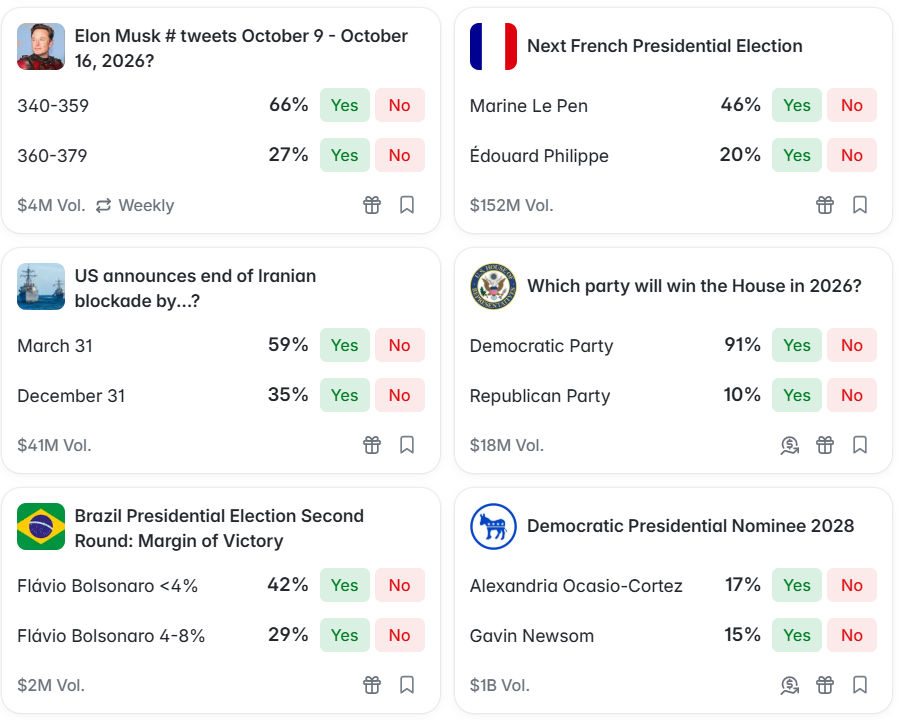
Elsewhere, the objections are more broadly focused on unlicensed gambling. In May, Spain’s gambling regulator opened proceedings against Polymarket and rival Kalshi for allegedly operating without the required authorisation, ordering their websites provisionally blocked.
France has taken a similar position on the legality of the platforms, but gone further in its enforcement. Polymarket introduced restrictions on French trading following regulatory intervention in 2024. However, the French gambling authority said Polymarket’s restrictions on financial transactions had been circumvented, while French visitors could still view live betting odds on the website. Arguing that displaying those markets amounted to promoting illegal gambling, it ordered internet providers to block the site in July 2026.
Across the Channel, Great Britain already has a licensing system that could accommodate prediction markets. The Gambling Commission considers them similar to betting exchanges, which have operated in the country for more than two decades. “The betting intermediary gambling licence exists to cover such business models,” it said in February. Betfair is already testing Betfair Predicts, allowing customers to make yes-or-no predictions on sports, politics and entertainment through its existing exchange.
Gibraltar, meanwhile, introduced its own dedicated prediction-market regulations in July.
A courtroom route to market
Polymarket’s Dutch case sets out its central argument. In its objection to the Kansspelautoriteit, operator Adventure One QSS argued that users trade with each other, that the platform is not the house and that research and skill influence trading decisions. It suggested financial derivatives regulation might be more appropriate than gambling supervision.
The regulator rejected those arguments on 23 June.
In France, Polymarket filed a legal petition in August to challenge the gambling authority’s decision to block its website, arguing that it had already stopped French users from trading in November 2024 but continued to offer access for informational purposes. “Prediction markets help source truth,” it said, maintaining that visitors should still be able to consult its forecasts without placing bets. The French regulator sees things differently. It considers the display of live betting odds on Polymarket’s homepage a form of promotion of illegal gambling, even when visitors cannot trade.
“Licensing gives consumers a supervised, accountable operator to trade on, and that is the outcome we are working toward,” the prediction market’s chief legal officer, Neal Kumar, said in a company statement. “Europe has the opportunity to set global standards for how prediction markets are regulated, and we want to be a constructive partner in that process, supporting a more integrated digital economy built around participation, transparency, and technological innovation,” he added.
Taking a page from Kalshi’s playbook?
The Financial Times reported in September that Polymarket was lobbying European and British financial authorities to recognise event contracts as financial instruments. The approach recalls Kalshi’s lawsuit against the US Commodity Futures Trading Commission (CFTC). Already licensed as a financial derivatives exchange, the prediction market company sued its own regulator in 2023 after it refused to allow contracts on which party would control Congress.
Kalshi’s co-founder, Tarek Mansour, later told Sequoia Capital that investors had warned against taking on the agency overseeing the business, fearing it could put the company at risk. “We bet the farm,” he said.
Kalshi won in 2024, when a federal judge ruled that the CFTC had exceeded its powers in blocking the election contracts.
The distinction between financial and gambling regulation carries enormous commercial consequences, and could shape the future of prediction markets elsewhere. As a CFTC-regulated exchange, Kalshi argues that its contracts fall under federal derivatives law rather than the US state-by-state licensing rules governing traditional sportsbooks, an argument that remains contested.
Yet classification as a financial instrument would not necessarily open Europe’s retail market. In July, the European Securities and Markets Authority warned that event contracts qualifying as derivatives may fall under existing national restrictions on binary options, prohibiting their marketing, distribution or sale to retail clients. Financial regulation could therefore present another obstacle rather than an alternative route to market.