France’s gambling regulator has raised the prospect of restricting certain sports bets to protect consumers, after new research found that some of the least prominent competitions attract an unusually high share of wagers from people flagged as excessive gamblers.
The findings, published on 12 October by France’s gambling regulator, the Autorité nationale des jeux (ANJ), come as sports betting continues to expand across the country. Online stakes reached €11.5bn in 2025, up 12 per cent on the previous year, while operators’ gross gambling revenue rose 10.4 per cent to €1.77bn.
But the regulator’s concern is no longer confined to how much people bet. It is also examining what they bet on, and whether the menu of available wagers encourages risky behaviour.
In the months preceding the ANJ report, the betting industry had been calling on French authorities to prioritise action against illegal gambling platforms. In a statement following the 2026 World Cup, the French Online Gambling Association (AFJEL), which represents licensed operators including Betclic and Winamax, argued that stronger enforcement against unregulated websites was essential to protecting consumers.
“The priority must now be clear: to concentrate public authorities’ efforts on combating the illegal market, in order to effectively protect players and preserve a regulated model that finances sport, the media and public finances,” the association said.
Where the money is going
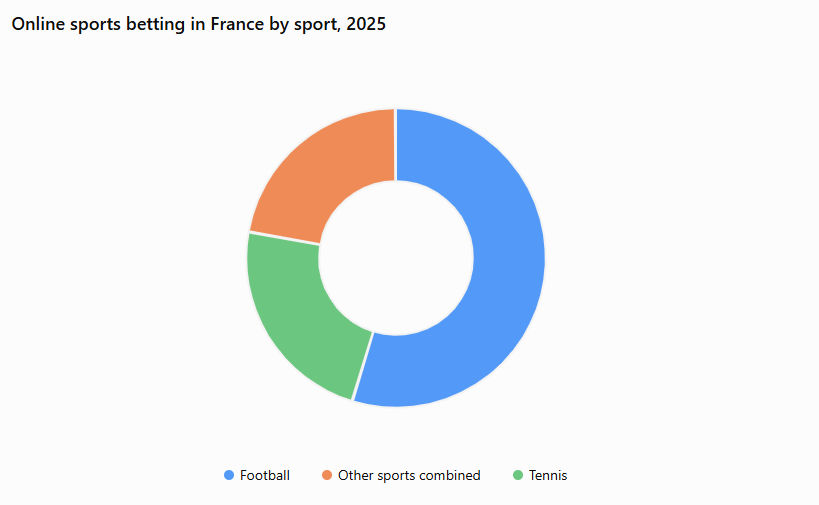
Football accounted for nearly 55 per cent of online stakes last year. The enlarged Champions League schedule helped drive growth, with the number of matches rising from 137 to 189 and stakes increasing by 48.6 per cent. Tennis accounted for 23 per cent of stakes, with the amount wagered rising by 16 per cent.
The boom continued at the 2026 World Cup. French bettors staked more than €1.3bn online during the tournament, more than double the 2022 figure. The France-Spain semi-final alone attracted €63m, the largest amount wagered on a single match since France opened its online betting market in 2010.
Live betting was also more prevalent in lesser-known football competitions. According to the ANJ, the share of in-play betting stood at 26 per cent for the Champions League and between 30 and 35 per cent for major domestic leagues, compared with 48 per cent for secondary competitions and as much as 58 per cent across certain lower-profile league categories, including European second divisions. The regulator also noted that fixtures across South America, Asia and Oceania allow operators to offer football betting almost continuously.
A question of which bets are allowed
The ANJ identified a high concentration of betting by excessive gamblers in several overseas football leagues. In the first half of 2026, people classified by its monitoring system as excessive or manifestly excessive gamblers accounted for more than 80 per cent of stakes on leagues in Brazil, Saudi Arabia, Japan and Australia.
The ANJ cautioned that the figures do not show those leagues are inherently more addictive. Recreational customers may simply have little interest in them.
A similar pattern emerged in bets on short periods of play, such as a half, quarter or tennis set. These attracted between 80 per cent and 89 per cent of their stakes from players in the two highest-risk groups, depending on the sport.
“This finding could, in time, make the case for integrating player protection into the regulation of authorised betting options,” the ANJ said.
France already maintains a list of permitted competitions and bet types, overhauled in 2024 largely to improve clarity and guard against match manipulation. Bringing gambling harm into those decisions would mark a change in emphasis, although no new restriction has been announced.
Tighter rules for young gamblers
The pressure for tighter safeguards extends beyond individual markets. A survey commissioned by the ANJ before the World Cup found that 37 per cent of regular bettors had felt they were losing control, rising to 67 per cent among those under 25.
New legislation, enacted on 3 August, gives the regulator powers from January 2027 to impose loss limits on gamblers aged 18 to 25 for periods of up to a year. The same law requires a waiting period of at least two weeks before young adults can increase their limits.
ANJ director general Pauline Hot warned in an interview with SiGMA last year: “Even if gambling is authorised and regulated, it should not become a product of everyday consumption.”
France has long taken a restrictive approach to online gambling, permitting sports betting, horse-race betting and poker while keeping online casino games prohibited. Although the ANJ determines which competitions and betting markets licensed operators can offer, broader changes to what forms of gambling are legal would require legislative action. With a presidential election scheduled for 2027, the longer-term direction of French gambling policy could still change.